

Tired of wasting your day on calls with prospects who never actually hire you? A paid consultation is your best filter, and knowing how much is a lawyer consultation fee to charge—typically between $100 and $500—is the first step to protecting your most valuable asset: your time.
But the fee itself isn't the magic bullet. The real challenge is building a payment and intake process so smooth that a qualified lead can become a paying client in minutes, not days. If your process has friction, you're giving them just enough time to call another firm—and you can bet your competitors are getting faster.
Why a Paid Consultation Is Your Best Client Filter
Charging for an initial consultation is the most effective way to separate serious leads from tire-kickers. It sends an immediate signal that your time and legal insight have real value, pre-qualifying leads before they ever hit your calendar.
A potential client willing to invest even a small amount shows a level of commitment that people seeking free advice lack. For your small firm, where every non-billable hour hits the bottom line, this is essential. Remember, 67% of clients choose the first firm that responds professionally. A clunky, multi-step process for paying a fee is anything but professional. You need a unified system, because the moment a prospect decides to pay is the moment you must capture them.
The Financial Case for Charging a Fee
The market is already on your side. Data from LawPay's report on legal industry trends shows a clear industry shift toward paid consultations as firms get smarter about protecting their time.
Today, 51% of law firms now charge for initial case reviews. These fees can be as low as $50 or climb to over $1,000, proving you won't be at a disadvantage by charging. You're simply positioning your firm as a premium service from the very first interaction.

Charging a fee changes the dynamic. You're no longer just a source of free information; you're a strategic advisor whose expertise is worth paying for. That small financial commitment is the first step in building a respectful, professional client relationship.
How to Strategically Price Your Consultation Fee
Deciding what to charge for a consultation isn't a guess—it's a business decision that attracts the right clients and ensures you're paid fairly for your expertise. Your fee needs to be grounded in the reality of your firm and the market.
Lawyer consultation fees vary widely, especially in major U.S. cities where hourly rates average $300-$400. This directly impacts consultation costs, which can land anywhere from $150 to $1,000. Most flat-rate consults sit in the $100-$500 range, but specialists in complex fields like intellectual property or bankruptcy will always command more.

You can see a more in-depth analysis of lawyer retainer fees for different structures, but a one-size-fits-all approach simply doesn't work. An experienced IP attorney in Silicon Valley should—and does—charge far more than a general practitioner in a small town.
Key Factors for Setting Your Consultation Fee
Base your pricing on these three pillars to justify your fee and communicate its value to potential clients.
- Practice Area Complexity: Are you handling niche tax law or complex business litigation? The more specialized your knowledge, the higher your fee. A routine real estate closing doesn't demand the same strategic horsepower as a federal case.
- Geographic Market: A lawyer in a major metro area with high overhead can and should charge more than a firm in a less competitive, lower-cost region. Research what other respected firms in your city are charging.
- Experience and Reputation: Your track record of success is a valuable asset. A senior attorney with a decade of courtroom victories brings a different level of value than a newly barred associate. Price your time accordingly.
Choosing the Right Fee Model for Consultations
After weighing these factors, pick a fee structure. Each model sends a different message to your clients and directly impacts your firm's law firm operations. For initial consultations, a flat fee is almost always the best choice. It gives clients price certainty, removing the anxiety of a ticking clock so they can focus on their legal issue, not your billable hour.
Here’s a breakdown of the most common models:
- Flat Fee: A single, upfront price for a set time (e.g., $350 for a 60-minute strategy session). This is the simplest, most transparent option, and clients appreciate it.
- Hourly Rate: Charging your standard billable rate. This can make clients nervous and is better suited for ongoing legal work, not the first meeting.
- Credited to Retainer: You charge a flat fee (say, $500) but agree to apply that amount toward the client's retainer if they hire you. This is a powerful conversion tool that makes the fee feel more like a down payment than a separate cost.
Free vs. Paid Lawyer Consultations: The Data
The debate over free versus paid consultations is really a choice between getting more leads or getting better leads. Many small firms default to "free" out of fear, but that strategy just fills your calendar with no-shows and people hunting for free advice, torching your most valuable asset.
Shifting to a paid model is about choosing quality over quantity. Even a modest fee introduces psychological buy-in. When a potential client pays, they become an active investor in solving their problem. This simple exchange transforms the meeting's dynamic and dramatically increases the odds they’ll hire you.
Why Paid Consultations Convert at a Higher Rate
The data is clear: paid leads convert better. A prospect who pays for your time has already cleared the biggest hurdle—the decision to spend money. They are showing you they have a real problem and are ready to invest in a solution.
That’s a critical step in turning an inquiry into a signed retainer. This is where you see the direct impact on your firm's efficiency. You spend less time on calls that go nowhere and more time with clients ready to move forward. This approach aligns perfectly with a strategy focused on faster client conversions, ensuring your leads are primed to become clients. Remember, leads contacted within 5 minutes are 21x more likely to convert. A paid consultation system that is instant and seamless capitalizes on that urgency.
Head-to-Head: Free vs. Paid Consultation Models
Does your firm want to maximize inquiry volume, or do you want to maximize your conversion rate and protect your time? Here’s how the two models stack up on the metrics that actually matter for your bottom line.
| Metric | Free Consultation Model | Paid Consultation Model |
|---|---|---|
| Lead Quality | Low. Attracts a wide net, including those seeking free advice with no intent to hire. | High. Attracts serious prospects who have decided to invest in solving their legal issue. |
| No-Show Rate | High. With no financial skin in the game, it's easy for prospects to cancel last minute. | Extremely Low. Payment creates commitment, ensuring prospects show up prepared and on time. |
| Conversion Rate | Low. Many leads are not qualified or serious, leading to a much lower rate of signed retainers. | High. Leads are pre-qualified and invested, resulting in a much higher consultation-to-client conversion rate. |
| Time Investment | High. Significant non-billable time is spent on calls with unqualified leads who never convert. | Efficient. Time is focused exclusively on serious, pre-qualified prospects, maximizing your ROI. |
For small firms focused on profitable growth and operational efficiency, the paid model is the clear winner.
The Hidden Cost of a Clunky Intake Process
You did it—a great lead found your firm, agreed to your consultation fee, and is ready to pay. Then, silence. The lead goes cold. This isn't bad luck; it's the direct result of a disjointed intake process that kills momentum and costs you clients.
Many firms create this friction without realizing it. It starts with phone tag, followed by one email with a payment link, a separate one for an intake form, and another to get the retainer signed. This administrative chaos doesn't just waste your team's time; it sabotages your conversions by giving motivated clients time to get distracted or call another firm.
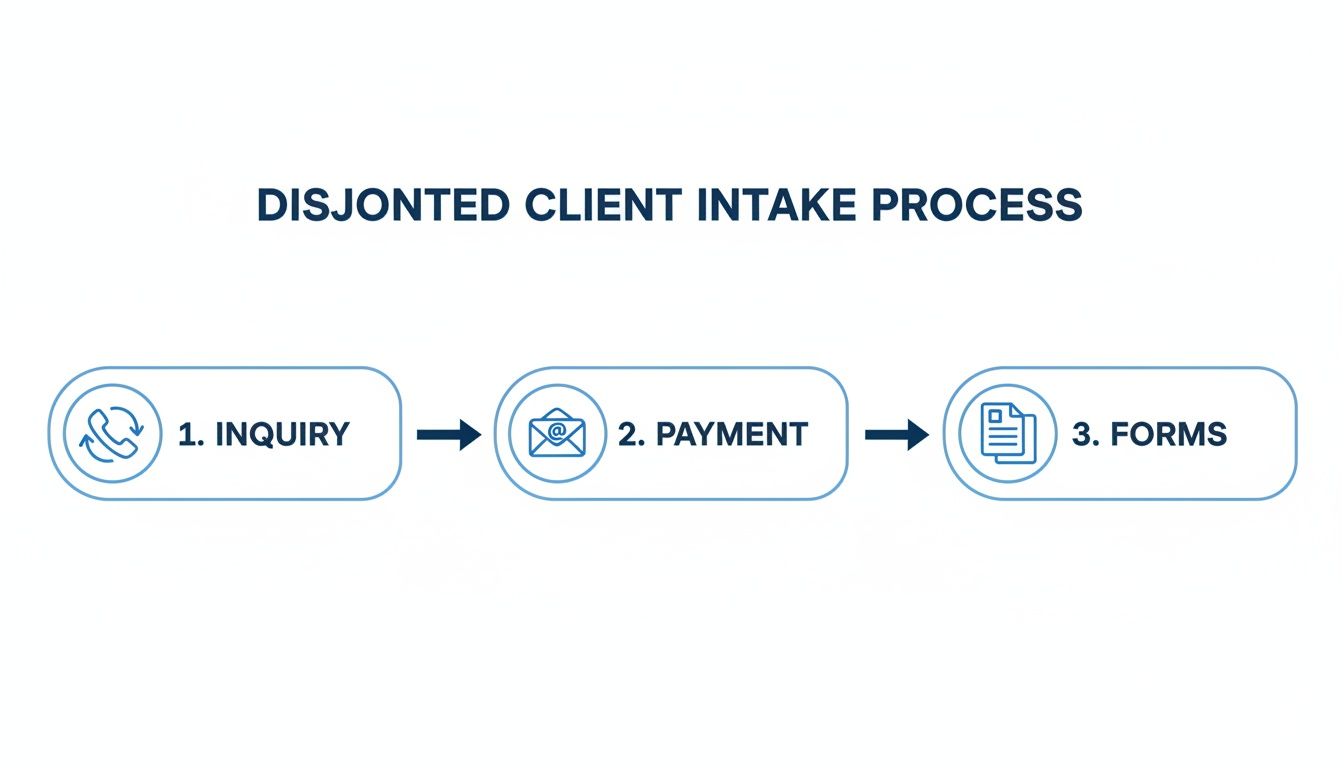
Each arrow represents a delay—another chance for a qualified lead to drop off. The problem isn't the client; it's the friction you've put in their way.
The True Price of Administrative Drag
This broken system drains your firm's resources. Think about the non-billable hours your staff spends chasing details: manual data entry from PDFs, follow-up emails to collect payments, and juggling information scattered across different platforms.
This administrative drag is a direct threat to your bottom line. Attorneys already spend an estimated 48% of their time on non-billable administrative tasks. A disjointed intake process pours gasoline on that fire, pulling you and your team away from billable work.
How a Unified Workflow Stops You from Losing Leads
The fix isn't working harder; it's working smarter with a unified system. The right client intake software for law firms consolidates these scattered steps into a single, seamless experience.
Instead of three emails, you send one link. On that single page, a client can schedule the meeting, pay the fee, and complete their intake form in one sitting. This simple change eliminates the administrative friction that causes drop-offs, getting you paid faster and delivering a professional experience that wins clients.
How to Convert a Paid Consultation into a Signed Retainer
You finished a great consultation. The client is qualified and understands your value. But the space between that verbal "yes" and a signed retainer is where countless leads vanish. Every manual step is an invitation for them to get distracted or call another firm.
Your goal is to make hiring you the easiest decision they make all day. That means having a seamless, one-link process that moves them from prospect to paying client in a single motion. Imagine ending a call and seeing a signed retainer and paid invoice in your inbox minutes later. It’s what happens when you eliminate the administrative friction in your workflow.
The One-Link Conversion Method
The old way—sending separate emails for payment, intake forms, and e-signatures—is a conversion killer. The modern solution is to collapse that chaos behind a single, intelligent link.
This one link does all the heavy lifting. A potential client clicks it and is guided through a simple workflow:
- Pay the Consultation Fee: They securely enter their card information.
- Complete the Intake Form: They provide all key case details.
- Sign the Retainer Agreement: They review and e-sign your fee agreement on the spot.
What used to be a multi-day headache becomes a five-minute task. You get paid instantly, capture all necessary info, and lock in a signed agreement before they can second-guess their decision. This is how you shrink your time-to-retainer from days to minutes.
Every hour of delay between a positive consultation and a signed retainer increases the risk of losing the lead. A one-link system closes that gap, making the decision to hire you both instant and irreversible.
Turning the Consultation Fee into a Down Payment
Here’s a powerful psychological shift: frame the consultation fee not as a one-off payment, but as the first step in hiring your firm. This is a core tactic for achieving faster client conversions. When a client pays the fee and immediately signs the retainer in the same workflow, it solidifies their commitment.
You can also structure your lawyer retainer fee to encourage a quick decision by clearly explaining how the initial payment will be applied. This approach reinforces your value from the start. Stop losing your best leads to slow, outdated processes.
How to Communicate Your Consultation Fee with Confidence
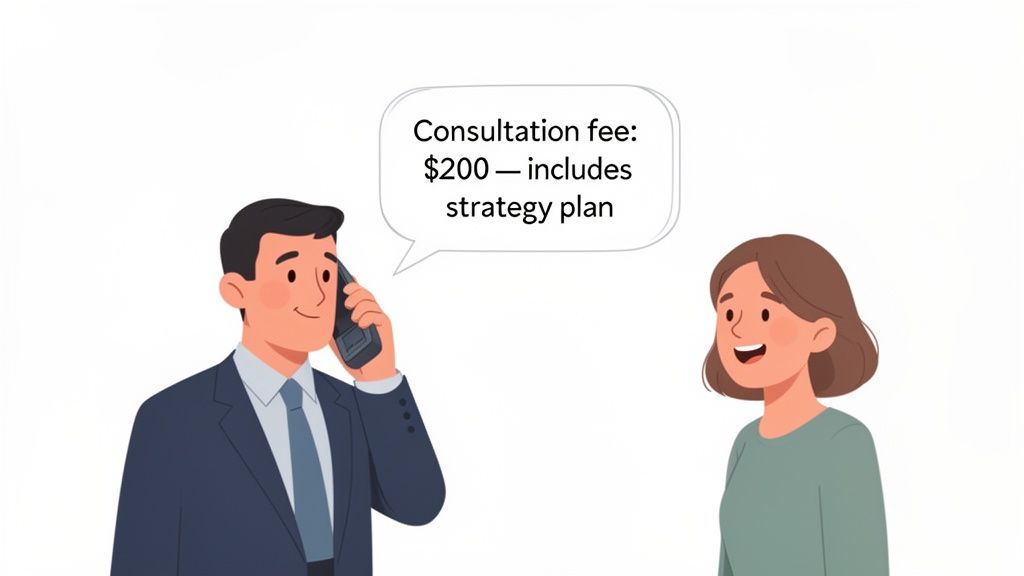
How you talk about your fee is as important as the number itself. If you just state a price, it feels like a hurdle. But when you frame it as a valuable strategy session, you immediately position your firm as a premium service.
Stop saying, "It's a one-hour meeting." You’re not selling an hour of your time; you’re selling a strategic advantage. You’re providing clarity and a path forward, and that’s worth far more than 60 minutes on a clock.
Scripting Your Value Proposition
When a prospect asks about your fee, your entire team needs a consistent, value-driven answer. This isn't just for phone calls; use it on your website and in email templates to justify the cost before you state it.
Here’s a simple script:
"Our initial strategy session is a flat fee of $250. During this meeting, we'll review your documents, identify the core legal issues, and map out a clear action plan with your next steps. It's a working session designed to give you clarity and direction."
This script does more than answer how much a lawyer consultation fee is. It immediately shows them what they get for their money, shifting the focus from cost to outcome.
Handling Objections and Building Trust
When someone pushes back on the fee, don't get defensive. Use it as an opportunity to reinforce your value. Transparency is your best tool here.
Clearly outline what the fee includes. This is also the perfect time to connect the consultation to the next step, like signing a retainer. You can make this smoother with a well-structured lawyer retainer letter that lays out your terms in plain English. When you communicate with confidence, you filter for serious clients and set the stage for a great professional relationship.
Answering Your Top Questions About Consultation Fees
You’ve decided to charge for your time. Excellent. Now let's tackle the practical questions so you can handle your new fee structure with confidence.
Should I Credit the Consultation Fee Toward a Retainer?
Yes, absolutely. Think of it less as a discount and more as a powerful conversion tool. Crediting the fee reframes it as the first step toward hiring you—a down payment on solving their problem. This small shift removes a psychological barrier and will boost your consultation-to-retainer rate.
Make the offer clear: “The $350 consultation fee will be fully applied to your retainer if you decide to hire our firm within 48 hours.”
What Is the Best Way to Collect the Consultation Fee?
Collect payment before the consultation is booked on your calendar. Not during, not after—before. This single step is the most effective way to eliminate no-shows and filter out non-serious prospects. Use an online system where the client pays as the final step to confirm their appointment.
Avoid manual invoicing or taking card numbers over the phone. It creates extra work, adds friction, and gives qualified leads a chance to drop off.
Is a Flat Fee or an Hourly Rate Better for Consultations?
For an initial consultation, a flat fee is almost always the better choice. It provides price certainty for the client and simplifies things for your firm. A statement like "$400 for a one-hour strategy session" is straightforward and easy for a client to process. Charging by the hour, on the other hand, creates anxiety, causing the client to watch the clock instead of focusing on their legal issue.
One link. Signatures, payment, intake—done before they call another firm.
Stop losing leads while you wait for paperwork. Get retainers signed in minutes with intake.link.