

Are you losing clients before they even sign your retainer? Tired of ending your day buried in paperwork instead of practicing law? For your small firm, innovation in law isn't about flashy, expensive tech—it's about fixing the broken processes that cost you time and money.
It means finding practical tools that stop you from playing phone tag and eliminate manual data entry. Real innovation lets your small team punch way above its weight, turning inquiries into paying clients before your competitors even call them back.
What Innovation in Law Actually Means for Your Firm

For a busy attorney like you, innovation isn't about chasing trends. It's about solving the daily headaches that are quietly costing you clients and cash. Think about the hot lead who went cold while waiting for you to draft a simple retainer agreement.
That's where the real money is. The biggest problem holding your firm back is the mountain of work you can't bill for. In fact, studies show attorneys spend 48% of their time on non-billable administrative tasks. That’s nearly half your week spent on things that don't generate revenue.
This is the silent killer of growth for so many small firms. You can learn more about how these administrative tasks impact law firms and what to do about it. For a deep dive into building systems that eliminate this waste, see our cornerstone guide to law firm operations.
Shifting from Manual Work to Automated Systems
This is where practical innovation comes in. It’s not about replacing your legal expertise—it’s about building smart systems that handle the repetitive, soul-crushing work for you. That way, you get to focus on what you do best: practicing law.
A small firm that embraces smart innovation can easily outperform a larger, slower competitor. The goal is simple: use technology to do more with less, turning administrative hours back into billable ones.
Take a look at how a few simple changes can completely reshape your firm's daily operations.
The Old Way vs. The Innovative Way Your Firm Can Operate
| Manual Task (The Old Way) | Innovative Solution (The New Way) | Direct Benefit to Your Firm |
|---|---|---|
| Playing phone tag to schedule a consultation. | Client self-books via an online calendar link. | Eliminates back-and-forth emails; you get booked while you sleep. |
| Emailing a PDF retainer for them to print, sign, and scan back. | Sending a single link for e-signature and payment. | Client signs and pays in minutes from their phone; you get paid faster. |
| Manually typing client intake data into your practice management system. | Intake form data automatically syncs with your systems. | Saves hours of staff time and completely eliminates data entry errors. |
| Chasing clients for missing information with follow-up calls. | Automated reminders for incomplete forms or unsigned documents. | Ensures you get what you need without staff intervention; nothing falls through the cracks. |
These aren't futuristic ideas; they are simple, available tools that fix the most expensive problems in your practice.
How to Use AI Without Breaking the Bank
Artificial intelligence sounds expensive and complicated, right? For a small firm, it probably feels like a luxury reserved for massive legal teams with their own IT departments.
That’s just not the case anymore. Practical, affordable AI is here, and it’s one of the most powerful forms of innovation in law you can get your hands on today.
Think of generative AI as the sharpest, fastest paralegal you’ve ever had. It's a tool that can draft a client follow-up email in seconds, boil down a 50-page deposition into key bullet points, or run initial legal research while you’re still on a client call. This isn’t about replacing your judgment; it’s about creating leverage.
Finding AI You Can Use Right Now
You don't need a massive budget to get started. Many of the most useful AI tools are already built into software you use or are available through simple, affordable subscriptions.
Here are a few high-impact, low-cost ways to begin:
- Document Drafting and Summarization: Use tools like ChatGPT or Microsoft Copilot to create first drafts of letters, memos, or client communications. You can also paste in long documents and ask for a tight summary, saving you hours of reading.
- Legal Research: AI-powered legal research platforms can sift through case law and statutes far faster than you ever could manually. They help you spot relevant precedents you might have otherwise missed.
- Email Management: Some tools can sort your inbox, draft replies to common client questions, and even schedule meetings for you. It’s all about cutting down on the administrative noise that pulls you away from real legal work.
The goal is to offload the 10-15% of your work that is repetitive and predictable. This frees you up to focus on strategy, client relationships, and complex legal analysis—the things only a lawyer can do.
Is AI Actually Being Used by Small Law Firms?
This shift toward AI isn't just some passing trend; it's a real movement happening across the entire legal field. You might be surprised to learn just how many of your peers are already on board.
According to the 2025 Clio Legal Trends Report, 79% of legal professionals are now using AI tools in their practice. Even solo practitioners are embracing the change, with 71% reporting they use AI.
That data sends a clear message: firms of all sizes are finding real, tangible value in AI. You can discover more insights in the full Clio report.
Addressing Privacy and Ethics in Legal AI
Of course, using AI in a legal context comes with huge responsibilities. The two biggest hurdles for any attorney are data privacy and ethical compliance.
First, never input confidential client data into public AI tools like the free version of ChatGPT. Doing so could torpedo attorney-client privilege. Instead, opt for enterprise-grade AI platforms built specifically for professional use. These come with robust data protection and privacy agreements that are designed to keep you safe.
Second, always verify the output. AI is a powerful assistant, but it’s not an attorney and it absolutely makes mistakes. You are ultimately responsible for the work product. Treat any AI-generated draft as a starting point—something to be reviewed, edited, and approved by you.
How to Innovate Your Client Intake Process
Your client intake process is your firm’s first handshake. If it’s slow, confusing, or full of friction, you’re not just making a bad impression—you’re actively losing clients before they even speak with you.
This is the single most critical area for immediate innovation in law, and for good reason: fixing it delivers instant returns.
Stop thinking about intake as just collecting information. It's the moment a potential client decides if your firm is the right one for them. When a prospect has to download a PDF, find a printer, sign it, scan it, and email it back, you've just given them homework. Each step is another chance for them to call the next attorney on their list.
The solution is a unified, one-link process that combines everything into a single, seamless flow. You can learn more about how the right tools achieve this by exploring the benefits of dedicated client intake software for law firms.
Make It Easy for Clients to Hire You
In the race for new clients, speed and simplicity win. A potential client in distress doesn’t have the patience for a clunky process. In fact, research shows that 67% of clients choose the first firm that responds professionally.
A fast, simple intake system is a professional response. It shows you value their time and are ready to act immediately.
The goal isn’t just to get the information you need. The goal is to capture commitment—a signed agreement and a paid retainer—while their intent to hire you is at its peak. Every hour of delay works against you.
To fix your broken intake and win more clients, optimizing your legal client intake form is non-negotiable. Keep it short, ask only for essential information upfront, and use conditional logic to hide questions that don't apply.
From First Contact to Signed Retainer in Minutes
So what does a modern, innovative intake workflow actually look like? It’s far simpler than the old way of doing things and cuts out the manual back-and-forth that eats up your staff's time.
The process flow below shows how AI can assist in backend processes like drafting, summarizing, and research after the client is already on board.
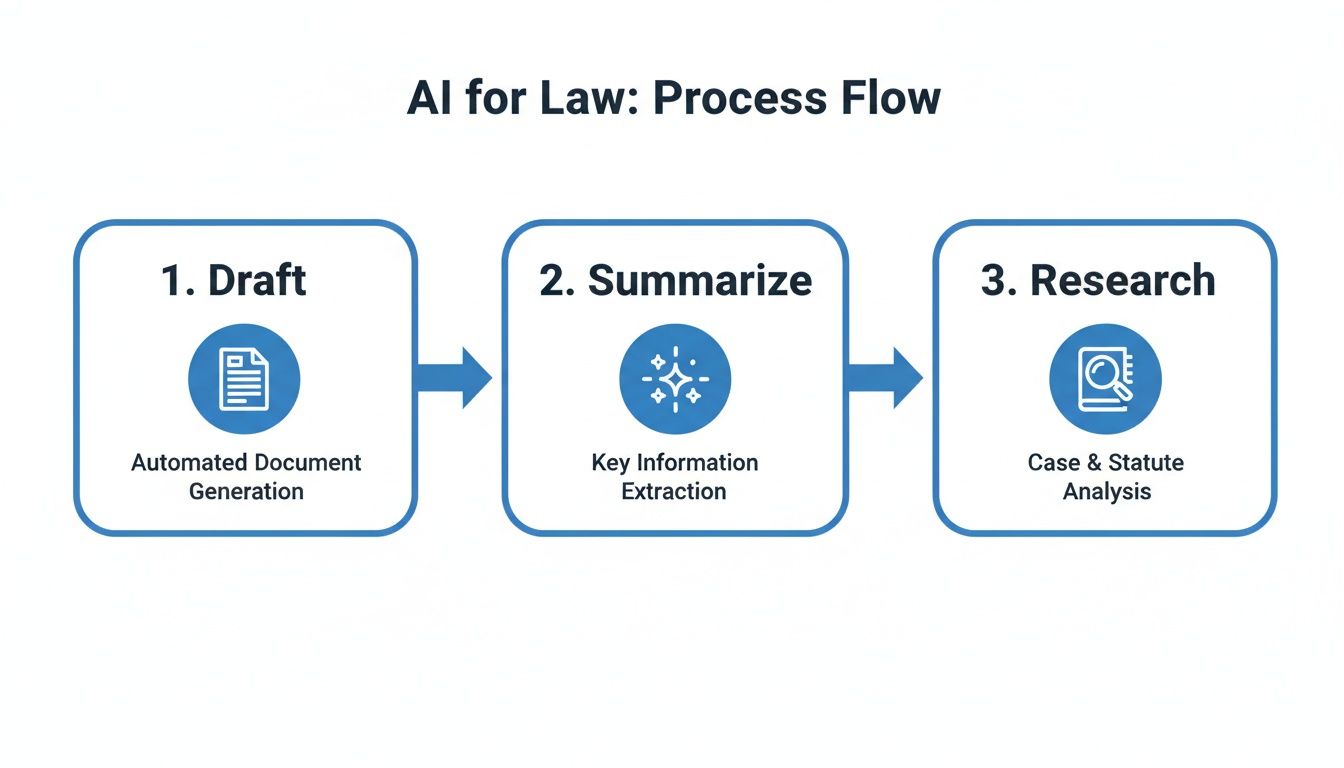
Here’s how an innovative intake system turns an inquiry into a paying client:
- Instant Response: A potential client fills out a form on your website. They immediately get an automated text or email with your firm's single intake link.
- Guided Onboarding: The client clicks the link and is guided through a simple, mobile-friendly process to fill out their intake questionnaire.
- Seamless Signing: Right after the form, your retainer agreement appears. They can review and e-sign it with their finger on the screen.
- Upfront Payment: Finally, they're prompted to pay the retainer or consultation fee via credit card, securing their commitment financially.
- Automatic Sync: The moment they finish, their signed agreement, payment confirmation, and all intake data automatically sync to your practice management software.
This entire sequence can happen in under 10 minutes, without a single phone call or manual email from your staff. You've captured a new client, collected payment, and eliminated data entry—all before your competition has even checked their inbox.
Automate Your Operations to Reclaim Your Time

If you're still manually typing client data, chasing down signatures, or sending payment reminders, you are burning through time that could be spent on billable work. Innovation in law doesn't have to mean a complex, expensive new platform. It's often about building simple, automated workflows that take care of the administrative grind for you.
Think of automation as a force multiplier. It's the system that lets a two-person firm do the work of four, freeing you from non-billable tasks. For most firms, this starts with putting the right legal case management software at the center of your operations.
Build Your Single Source of Truth
The biggest resource killer in any small firm is scattered information. When client details live in your email, documents are on a shared drive, and payment history is in a spreadsheet, your team wastes precious minutes just piecing everything together.
The objective is to create a unified hub where everything about a client or matter lives in one place. This means connecting the tools you already use so they talk to each other automatically. You can see how platforms connect by checking out our guide to the best legal CRM software and their integration options.
Key Areas for Immediate Automation
You don't need to automate your entire practice overnight. Just start with the tasks that cause the most headaches and eat up the most time.
Here are three high-impact areas to focus on first:
- Document Management with Templates: Stop drafting the same retainer or engagement letter from scratch. Use templates with merge fields that automatically pull client data from your intake forms.
- Streamlined E-Signature Implementation: Connect your e-signature tool (like DocuSeal) directly into your workflow. Instead of emailing a document and waiting, the signature request can be triggered the moment a client completes their intake form.
- Automated Communication: Set up simple workflows that send appointment reminders, request missing documents, or confirm payment receipts—all without any manual effort from your staff.
These small changes add up fast, reclaiming dozens of hours every month. The secret is to identify the repetitive tasks and build a system that handles them for you.
How to Connect Your Systems Without a Developer
The idea of "integrating systems" might sound technical and expensive, but it's more accessible than ever. Tools like Zapier or Make.com act as a bridge between your different software applications.
For example, you could create a simple workflow that does the following:
- Trigger: A new client completes a form in intake.link.
- Action 1: Their contact info is automatically added to your email list.
- Action 2: A new client folder is instantly created in your Google Drive.
- Action 3: A task is automatically assigned to your paralegal to start a conflict check.
This entire sequence runs in the background, making sure nothing falls through the cracks and saving your team from tedious, error-prone data entry.
The real power of operational automation is consistency. It guarantees that every client receives the same professional experience and that every internal process is followed, every single time, without you having to think about it.
By automating your backend, you can finally focus on the parts of your practice that truly drive growth.
How to Speed Up Conversions from Lead to Retainer
Every hour you delay responding to a new lead, that potential client is dialing your competitor. In the business of law, the race to turn an inquiry into a paying client is a sprint. Practical innovation in law is about removing every obstacle that stands between a prospect saying "I need help" and you getting a signed retainer.
This isn't about being pushy; it's about being responsive. A lead who reaches out is in a moment of urgent need. If your process involves phone tag and manual paperwork, you're signaling that their problem isn't a priority. Speed isn't just a convenience—it's your most powerful competitive advantage.
Why Your Response Time Is Everything
The first few minutes after a potential client contacts you are the most critical. This is the window where their motivation is at its peak and their decision is being made.
The research on this is startlingly clear: leads contacted within five minutes are 21 times more likely to convert. Waiting any longer doesn't just lower your odds; it makes winning their business nearly impossible. You can see the full research on lead response impact for yourself.
Close the Deal with Upfront Payments
One of the biggest mistakes small firms make is separating the intake process from the payment process. You get the client to sign the retainer, then send a separate invoice and hope they pay. This creates an unnecessary gap where doubt can creep in.
The most effective modern workflow combines intake, signature, and payment into one seamless action. When a client completes their intake form and signs your retainer, the very next screen they see should be a simple, secure payment portal.
Capturing the retainer payment at the moment of signing transforms a warm lead into a committed client. It solidifies the relationship instantly and eliminates the time-consuming process of chasing payments later.
This single change does more than just get you paid faster. It acts as a powerful psychological confirmation for the client, affirming their decision to hire you and officially putting you in their corner.
Key Bottlenecks in Client Conversion and How to Fix Them
| Conversion Bottleneck | Why It Loses You Clients | The Innovative Solution |
|---|---|---|
| Delayed Initial Response | Prospects are in decision mode and contact multiple firms. The first to respond often wins. A delay feels like indifference. | Implement an automated email/SMS response system to provide immediate acknowledgment and set expectations. |
| Complex Intake Forms | Long, confusing forms cause prospects to abandon the process. Each unnecessary question increases the drop-off rate. | Use a streamlined, mobile-friendly form that only asks for essential information needed to qualify and start the case. |
| Separate Signature & Payment | Sending multiple links (one for signature, one for payment) creates two chances for the client to get distracted or change their mind. | Adopt a unified intake flow where the client signs the retainer and immediately proceeds to a payment screen in the same session. |
| No Follow-up on Hesitant Leads | Leads who aren't ready to sign immediately are forgotten, left to be scooped up by competitors who stay in touch. | Use an automated "nurture sequence" that sends helpful content and gentle reminders over a set period to keep your firm top-of-mind. |
Fixing these bottlenecks isn't about a massive technological overhaul. It’s about being more responsive and making it incredibly easy for people to hire you.
Nurture Hesitant Leads Without Lifting a Finger
Of course, not every lead is ready to sign on the spot. Some need more time to think. That doesn't mean you should let them go cold. This is another area where a small investment in innovation in law pays huge dividends through automated follow-up.
Instead of manually tracking who to call, you can build a simple email or text message sequence that automatically nurtures these leads for you. For example:
- Day 1: Send an email with a link to a helpful blog post on your site. For more ideas, check out our guide on effective marketing for lawyers.
- Day 3: Send a short client testimonial or case study relevant to their problem.
- Day 7: Send a final, direct message inviting them to book a quick 15-minute call to answer any remaining questions.
This system keeps your firm top-of-mind and demonstrates your value without you having to manually send a single email. It ensures that when they are finally ready to move forward, your name is the first one they think of.
Your Simple Action Plan for Legal Innovation
Feeling buried under all the tech options? Don't be. Real innovation in your law practice isn't about doing everything at once. It's about making one smart change that solves your biggest problem.
First, forget the buzzwords and find the real pain point. For most small firms, that's the chaotic client intake process—the black hole where hot leads go to die. Don't try to overhaul everything at once. Start with the one thing that costs you the most money: lost clients.
Once you’ve zeroed in on that critical bottleneck, your next job is to pick a single tool designed specifically to solve it. You need a targeted solution that does one thing exceptionally well, like getting retainers signed and paid in minutes instead of days.
A Quick Checklist for Evaluating Legal Tech
When you start comparing tools, it's easy to get distracted by endless feature lists. For a small firm like yours, only a few things truly matter.
Use this simple checklist to stay focused:
- Ease of Use: Can your team figure it out in under an hour? If it’s not dead simple, it won’t get used.
- Solves One Critical Problem: Does it directly fix your biggest headache, like chasing signatures or slow intake?
- Key Integrations: Does it connect with the software you already depend on, like your practice management system?
- Transparent Pricing: Are the costs crystal clear with no hidden fees or long-term contracts required?
This focused approach helps you sidestep analysis paralysis and start seeing a return on your investment almost immediately.
Start Small, Measure Your Results
Once you've picked your tool, commit to it for 30 days. Fully integrate it into your workflow for every new client. At the end of the month, look at the numbers.
Innovation isn't a project with an end date; it's a mindset of continuous improvement. The goal is to make small, measurable changes that compound over time, freeing you up to practice law.
Track these simple metrics:
- Time-to-Retainer: How long does it now take from the first call to a signed, paid retainer?
- Lead Conversion Rate: Are you successfully signing a higher percentage of qualified leads?
- Admin Hours Saved: How much less time is your team spending on data entry and follow-up?
For small firms, this is how you get real ROI. Modern platforms that integrate secure tools like Stripe for payments and DocuSeal for e-signatures tackle security issues head-on, delivering major efficiency gains. You can read more about these legal tech trends and see how they drive growth.
This is how you build momentum. A win in your intake process makes it much easier to take on the next bottleneck. Start small, prove the value, and then expand.
Common Questions About Innovation in Law
You've seen what's possible, but it's normal to have questions before you start changing the way your firm operates. Let's tackle the most common concerns we hear from lawyers at small firms.
Is legal tech too expensive for a small firm?
Not anymore. The old idea that meaningful technology requires a massive upfront investment is outdated. The best tools—especially for client intake and workflow automation—run on affordable monthly subscriptions built for small businesses.
Stop thinking of it as a "cost" and start seeing it as an investment. If a $50/month tool saves you five non-billable hours and helps you land just one extra client you would have otherwise lost, it has already paid for itself many times over.
How do I get my team to actually use new software?
Adoption lives and dies by one thing: simplicity. If a new tool is clunky or requires weeks of training, your team will rightfully push back.
The secret is to start with software that solves the single most annoying problem in your office. Choose a tool with a clean, intuitive interface that requires almost zero training. When your team sees that a new system eliminates tedious data entry, they won’t just adopt it; they’ll become its biggest fans.
Are my clients tech-savvy enough for online intake?
Absolutely. Your clients already manage their banking, schedule appointments, and order just about everything from their phones. They don’t just tolerate digital convenience; they expect it.
Giving them a simple, mobile-friendly way to hire you is seen as more professional and respectful of their time. The old way of asking them to print, sign, and scan documents just feels archaic and inconvenient now.
Explore how unified workflows replace scattered tools. With intake.link, you can replace half a dozen apps with one link that gets your retainers signed and paid in minutes, not days.